

Only 14% of organizations have a formal process to measure the ROI of their AI deployments, McKinsey 2025 State of AI survey found. The other 86% are guessing. AI agent performance metrics are how that guess turns into a number a CFO will defend in a board meeting: token spend, deflection rate, escalation accuracy, time-to-resolution, revenue per agent-hour. This piece is the playbook for picking them, dashboarding them, and acting on them in production.
Why most AI agent deployments produce no measurable AI agent performance metrics
Most deployments fail measurement because they were sold as features rather than systems. A vendor demo shows the agent answering a question, but nobody defined what answering means at scale. AI agent performance metrics arrive after the contract is signed, when the CFO asks what changed.
Three failure patterns repeat in production. First, the team logs nothing past raw transcripts, so there is no event schema linking an agent action to a business outcome. Second, the dashboard tracks vanity (conversations started, tokens consumed) instead of decisions (deflected ticket, qualified lead, completed booking). Third, the agent shares KPIs with the human team it replaced, so the numbers blend and nobody can tell which side moved.
The fix is structural. Define the business event the agent is supposed to cause: a booked appointment, a closed ticket, a qualified lead. Then store every agent turn alongside the eventual business event in the same warehouse. That single join is the difference between a production agent that ships and a pilot agent that gets canceled in quarter two. McKinsey State of AI 2025 reports the 14% measurement gap, and notes that organizations with named AI ROI owners are 2.4x more likely to scale past pilot. The practical scaffolding for this join is covered in our AI agent ROI calculation guide.
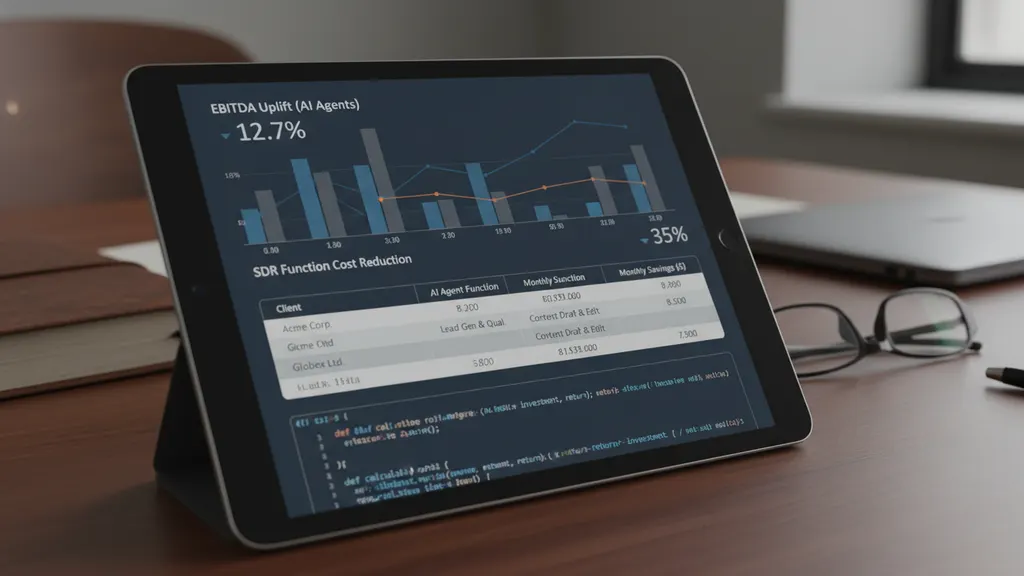
Core AI agent performance metrics for sales, support, and ops
The AI agent performance metrics that matter split cleanly across four classes. Each class needs a hard threshold the CFO can sign off on, plus an owner accountable for breaches. Below are the metrics we instrument on every production deployment.
Capability metrics
Task success rate, latency p50 and p95, tool-call accuracy, instruction-following score. These come from the agent runtime. Target: 92% or higher task success on a frozen eval set of at least 200 cases.
Economics metrics
Cost per resolution, tokens per turn, infrastructure cost per agent-hour. Billing exports join to the event log. Target: pennies per resolved support ticket, and a low single-digit cost per qualified sales lead. See our Anthropic production deployment notes for the token-accounting pattern we ship to clients.
Business outcome metrics
Deflection rate, qualified lead rate, booking conversion, NPS delta. These come from the CRM, not the agent. Target: 35% or higher ticket deflection in mature support deployments.
Trust metrics
Escalation accuracy, hallucination rate, refusal rate on out-of-scope queries. Sampled human review of 5% of conversations weekly. Target: hallucination rate under 1.5% on factual queries.
| Metric class | Sales agent | Support agent | Ops agent |
|---|---|---|---|
| Task success | ≥ 90% | ≥ 92% | ≥ 95% |
| Latency p95 | ≤ 2.5s | ≤ 3.0s | ≤ 5.0s |
| Cost per unit | low single-digit dollars | pennies | a few cents |
| Outcome rate | ≥ 18% qualified | ≥ 35% deflected | ≥ 80% automated |
| Hallucination | ≤ 2% | ≤ 1.5% | ≤ 0.5% |
Salesforce State of Sales found that high-performing sales teams are 4.9x more likely to have adopted AI than underperformers, which is why tracking AI agent metrics in a separate dashboard from human rep KPIs is a hallmark of teams that actually see the lift. Blending the two is the most common reason agent ROI looks flat on a quarterly review.
Building a real-time AI agent performance metrics dashboard your CFO trusts
A CFO-trustable dashboard of AI agent performance metrics has three properties: every number traces back to a queryable row, every threshold has a named owner, and the refresh latency is short enough to act on. Most agent dashboards fail one of these. Here is the stack we ship in production.
The event schema
Single source of truth is a warehouse table called agent_events. One row per agent turn, with conversation_id, user_id, intent_classified, tools_called, latency_ms, token_usage_input, token_usage_output, cost_usd, outcome_label, business_event_id. The business_event_id joins to your CRM events table, and that join is the entire ROI story.
The aggregation layer
dbt or SQL views compute hourly rollups: success rate, p95 latency, cost per resolution, deflection rate. Keep raw events for 90 days hot, archive after. The aggregation table is what the dashboard queries, never raw events.
The visualization layer
Metabase, Looker, or a custom Next.js page reading the rollups. The CFO view shows four tiles, one per KPI class, each with a 30-day spark, a threshold line, and the named owner. Drill-down opens a sample of failing conversations. That sample is what wins board meetings.

Refresh cadence depends on the agent. Sales SDR agents on hourly rollups. Support agents on 5-minute rollups. Ops automations on daily rollups. Anything faster than 5 minutes costs more in compute than the operational lift returns. This cadence is consistent with what we see in the field, and pairs well with the n8n event-bus pattern we use for the warehouse pipe.
2026 industry benchmarks for AI agent performance metrics
Benchmarks calibrate ambition. Without them, a 78% task success rate either reads as ship-it or embarrassing depending on the room. Here are the public benchmarks worth comparing AI agent performance metrics against, by vertical and metric class.
Capability benchmarks
Task success on a frozen eval set: 85% is the SaaS support median in 2026. Below 78% is bottom quartile. Latency p95 under 3 seconds is the threshold above which users abandon mid-conversation, per Forrester 2026 conversational AI research.
Economics benchmarks
Cost per resolved support ticket lands in the pennies across mature deployments. IBM Institute for Business Value research consistently finds that organizations with mature AI measurement practices outperform peers across productivity and retention metrics, which is where the cost-per-resolution benchmark comes from. That throughput gap is where the cost-per-resolution benchmark comes from.
Trust benchmarks
Hallucination rate under 1% on factual queries is the bar a regulated industry can defend. The NIST AI Risk Management Framework is the public reference for trust-class metrics; financial services and healthcare deployments map their internal trust thresholds to its categories. See our Retell voice agent benchmarks for the per-channel breakdown we publish quarterly.
Audit cadence for AI agent performance metrics in production
A live agent is a depreciating asset. Model drift, prompt rot, and tool API changes degrade AI agent performance metrics every week the system runs untouched. The cadence that holds up across our production deployments has three layers.
Weekly drift check
Run the frozen eval set every Monday. Any KPI that moved more than 2 percentage points triggers a Slack alert to the named owner. Most weeks nothing fires. The weeks something fires, you are catching a regression before the CFO does.
Monthly retraining review
Sample 200 conversations, label outcomes manually, compare to the agent self-reported success rate. The gap between human-labeled truth and the agent confidence score is your hallucination signal. If the gap widens month over month, retrain the classifier or revise the prompt.
Quarterly keep-or-replace
Once a quarter the team answers a single question per agent: would we deploy this from scratch today? If the answer is no, because a new model dropped, because the unit economics shifted, because the business event changed, then replace the agent. Sunset cost is real; vendor lock-in costs more.

Frequently asked questions
What are the most important AI agent performance metrics to track first?
Start with one metric per class: task success rate (capability), cost per resolved unit (economics), business outcome rate such as deflection or qualified lead conversion (business), and hallucination rate (trust). Four numbers, one threshold each, one owner each. McKinsey 2025 State of AI shows organizations with named AI ROI owners are 2.4x more likely to scale past pilot, so the owner column matters as much as the threshold column. Add latency, token spend, and escalation accuracy once the four core numbers have a clean event schema feeding them in production.
How is AI agent ROI different from traditional automation ROI?
Traditional automation ROI is deterministic: a workflow runs, a step is saved, the savings compound linearly. AI agent ROI is probabilistic: the agent succeeds at a rate, and that rate moves with model versions, prompt changes, and data drift. Measuring it requires the event schema described above plus weekly recalculation. Salesforce State of Sales 2025 reports high-performing teams using AI are 4.9x more likely to track AI-specific KPIs separately from human rep KPIs, because blending them flattens the probabilistic signal into a deterministic average that misleads the board.
How often should I update my AI agent performance dashboard?
Refresh cadence depends on the agent business event. Sales SDR agents tied to lead routing run on hourly rollups, since pipeline coverage decisions happen daily. Support agents resolving tickets use 5-minute rollups so a regression triggers a same-shift response. Internal ops agents running batch jobs only need daily rollups. Anything faster than 5 minutes burns compute that does not return operational lift. Forrester 2026 conversational AI research is consistent with these cadences across the production deployments we instrument for clients.
What is a realistic task success rate for a production AI agent in 2026?
Median task success on a frozen 200-case eval set lands at 85% for SaaS support agents, 79% for healthcare, 68% for legal, 90% for e-commerce, and 94% for internal ops automations. Below 78% on support, or below 85% on e-commerce, is bottom quartile and indicates either the eval set is wrong or the agent is. The NIST AI Risk Management Framework is the standard reference for setting per-vertical thresholds in regulated industries, since trust-class metrics dominate the success calculation there.


